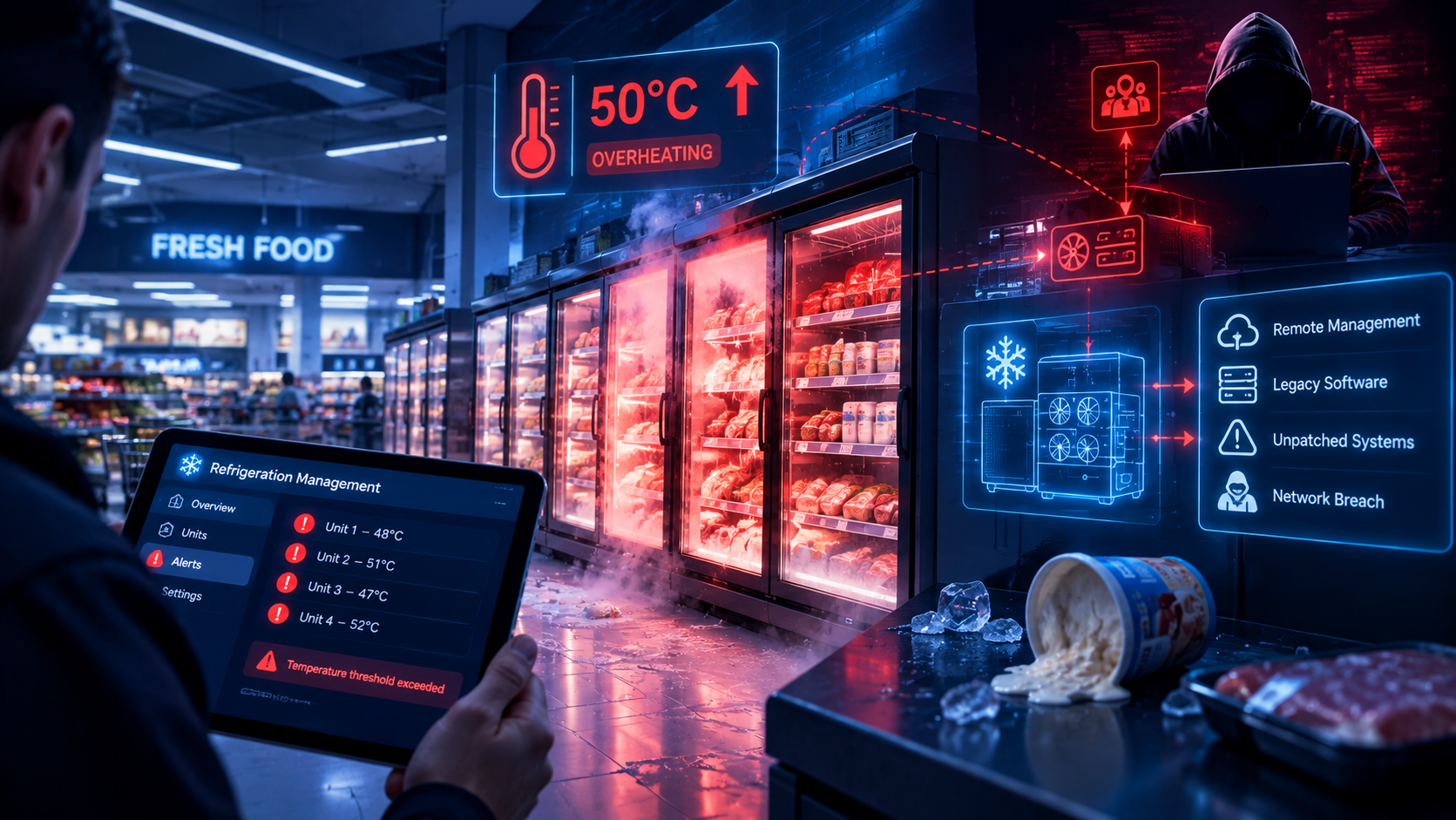
Few people look forward to returning to work on a Monday morning after a relaxing weekend. For employees at major supermarkets across France, the start of the week was particularly unpleasant. On Monday, 12 October, many arrived to the smell of spoiled meat and melted ice cream spreading across supermarket floors.
Sounds like something out of a bad fever dream, but unfortunately, it’s real.
Hackers launched a coordinated cyberattack that crippled the refrigeration systems of approximately 400 supermarkets across France. Major retail chains, including Intermarché, Coopérative U, Carrefour, and E. Leclerc, woke up to their refrigerators close to cooking their food with temperatures rising to a scorching 50°C (120°F) overnight.
For business leaders outside of retail, this isn’t just bizarre overseas news. It’s a massive wake-up call about how our physical infrastructure has become the next major attack surface. Here is exactly what happened:
The Convenience of Remote Control
To understand how a digital hack can spoil millions of pounds of food, you have to look at how modern commercial spaces operate.
Supermarket chains and many other modern businesses, turn to technologies and equipment that optimises efficiency. To save time and streamline operations, retail giants rely on centralized software, such as remote management systems provided by engineering firms like Denmark’s Danfoss. These systems allow facility managers to monitor and control refrigeration units from afar.
For corporations, this seems like a good solution since they get seamless operational visibility, optimized energy consumption, and total automation. But every remote connection comes with its risks.
The Overheating Plot Twist
And as it was more a matter of “when” not “if, bad actors managed to exploit it.
Industry analysts had previously warned that older refrigeration controllers running unpatched or legacy software contain flaws that could allow outside access.
Bypassing standard security checkpoints, the attackers broke into the remote management network, seized control of the cooling units, and overrode their built-in safety boundaries. Instead of running a normal, brief daily defrost cycle, the units were locked into continuous heating mode for roughly six hours.
The result? Freezers and display fridges were transformed into ovens. In some locations, the extreme thermal overload even sparked localized fires. Supermarket operators arrived on Monday morning to find their stock destroyed and their physical infrastructure weaponized against them.
The Reality of Physical Disruption
When European officials surveyed the damage, the gravity of the situation set in immediately.
EU food and agriculture commissioners and retail executives openly condemned the attack, noting that the weaponization of food supplies and physical infrastructure has shifted from theoretical risk to everyday reality. As supply chains become increasingly digitized, an exploit can manifest as physical damage, financial ruin, and public health hazards in the real world.
The Million-Dollar Takeaway for Modern Businesses
The French supermarket scandal exposed a major flaw in how modern businesses approach digital transformation. If your company connects physical machinery, HVAC systems, operational tech, or inventory storage to the internet, you need to learn three golden rules:
- Beware of the “Legacy Blind Spot” Just because a piece of hardware is hidden away in a utility room or a rooftop compressor doesn’t mean it’s safe. Older equipment running unpatched, legacy firmware is an open invitation for attackers.
- Convenience Should Never Outweigh Control Remote management features are incredible for productivity, but they should never have unconstrained authority over physical equipment. True security requires strict segmentation, strict outbound traffic rules, and multi-layered fail-safes that prevent a single software breach from causing physical disaster.
- Cybersecurity is No Longer Just About Data Hackers are shifting their focus from stealing passwords and data files to disrupting physical operations – shutting down shipping, halting production lines, and frying physical infrastructure.
How a Smart IT Partner Keeps You Grounded
You don’t need to avoid modern technology or smart automation; you just need to build a better safety net. That is exactly what we do for our clients.
The tech frontier moves incredibly fast, and the threats are evolving past the computer screen. Don’t explore it without a co-pilot who knows where the cliffs are.
Reach out to our team at KP Consulting today, and let’s build an infrastructure strategy that is both innovative and bulletproof.